Edible Oil Refinery Plant - Chemical Refining

Thursday, February 23, 2012

What is Oil Refinery and Edible Oil Refinery?

When talking about refinery, we need to be able to differentiate and identify an oil refinery from the edible oil refinery. Basically, the oil refinery (or petroleum refinery) is an industrial process plant where crude oil (from crude petroleum) is processed and refined into more useful petroleum products, such as gasoline, diesel fuel, asphalt base, heating oil, kerosene, and liquefied petroleum gas. This is the type of refinery mentioned in the 13 Days: Pythagoras Conspiracy Novel. An edible oil plant in the other hand, is almost similar to the earlier refinery accept it processes edible oil and involves the removal of fatty acid and a few more unwanted impurities. The edible oils are obtained from the likes of palm oil, soya bean oil, canola oil, corn oil, rape seed oil and others. In other words, the oil refinery process oil that cannot be consumed by human being while the edible oil refinery process oil that is edible (can be consumed by human beings).

I have no direct involvement in the oil refinery. However, I was a process engineer in an edible refinery plant before for quite some time. I had a really good taste of experience working in the refinery plant before. I strongly believe that if a chemical engineering student or a new chemical engineer wants to gain experience, he or she should work in a refinery. This is mainly because they will learn and apply all that they have learn in chemical engineering.

Edible Oil Refinery

Edible oil originates from crude oil such as crude palm oil (CPO), crude soya bean oil (CSBO), crude rape seed oil (CRSO), crude coconut oil (CCO) and so on. Edible oils have very high content of free fatty acids (FFA) and needs to be refined before using as cooking oil. However, the refinery process isn't only limited to remove FFA, it also removes the undesired components such as moisture, color and odour which may trigger negative impact on the final taste, odour and appearance of the oil product. The resultant oil is thinner without fatty acids, colorless and odorless.

It is imperative to note that the edible oil refinery can be divided into 2 primary types namely, chemical refining and physical refining. This time, I'll explain about the chemical refining plant.

Chemical Refining Plant

Chemical refining plant involve neutralization of crude oil by removing fatty acids. This is always referred to as chemical refining or sometimes Neutralizing process and its plant referred as Neutralizing Plant (NP). In this process the oil is neutralized in the neutralizer to remove the fatty acids by mixing with caustic soda (sodium hydroxide). Oil is heated up to roughly 60oC by and oil is stirred by stirrer. The fatty acids are settled at the bottom as alkali soaps which is called soapstock from where it is taken out into soap tank .

Typical Neutralizing Plant. Image credited to Oiltek Sdn Bhd, a Malaysian company that manufactures edible oil equipments. Click on the photo to enlarge it.

Removal of impurities and color

Neutralized oil is passed through the second vessel called bleacher where color of oil is removed by bleaching process with the help of chemicals such as carbon black and bleaching clay. Oil is usually heated up to 110oC. Stirring is also carried on. Bleaching process is done under vacuum. Bleached oil then goes to filtration process where bleaching clay and chemicals are removed and cleaned.

Removal of unpleasant smell

Bleached oil is then passed through deodorizer where oil is heated above 110C and then live steam clean is used to the oil from the bottom steam nozzles. The temperature of oil is raised up to 200 to 220C through thermic fluid coils. Entire process is done under high vacuum. Thus smell is removed from the oil in the deodorizer. Then it goes to cooler where cold water circulating coils take away heat and oil is cooled.

Final Filtration

Final filtration is performed after cooling down the oil. This operation is carried out in a micro filter closet or filter bag/filter cartridge which makes the final edible oil termed as refined edible oil. This final filtration process is designed for more effective filtration and best quality of final refined edible oil. There are certain refineries that adopted Hazard Analysis Critical Control Point (HACCP) to completely ensure that the oil is free and safe to be consumed.

This is a typical physical refinery plant. The image is also credited to Oiltek. Click the image to enlarge it.

In the next post, I'll describe more about the Physical Refinery. This is where I gained the most of my hands on chemical engineering experiences. This is where I learned more about important unit operations such as heat exchanger, cooling tower, deodoriser, pack coloumn etc.


.......................................................................

HIGHLY Recommended GREEN Info Product
"Don't buy solar panels. Instead, Build them - like they did!" Watch the FREE video presentation NOW and discover…
  • Why you should run like hell from $10,000 and $20,000 retail solar panel systems
  • A little known way to slash your electric bill by 80% or more (or even get off the grid entirely)
  • How a “technologically retarded” guy stumbled on a way to generate free energy with homemade solar panels
  • A simple, 5-step process for building your own low-cost solar panels
  • And how to say “goodbye” to the electric company… and “hello” to clean, FREE electricity!
>> Click HERE:- Watch the FREE video presentation NOW!!!

-------------------------------------------------------------------
FREE Recommended magazines to get you updated with current engineering news

Have you downloaded my free "Choosing Alternative Fuel" Ebook? If not, then please download it here. It's Free and on top of getting the free ebook, you'll get eCourse on Alternative Fuel. It's a good and easy way to add more valuable information to yourself.


13 Days: The Pythagoras Conspiracy - A Must Read Chemical Engineering Fiction Novel

Tuesday, February 14, 2012

It is one of my dream to write a chemical engineering related fiction novel. My wife knows that fact. It will be cool to integrate the experience which I had in the industry and my chemical engineering knowledge in a book which can be read by everybody (but special for chemical engineers and those who are in related industry). What if the novel is adopted to become one of those Hollywood movies. Would that be great? However, I don't think I can make it in the near future. It's quite tough especially with my hectic schedule and my main target to complete my Ph.D. Well, enough about that.

However, the actual interesting point that I would like to share is a new Chemical Engineering related fiction novel that has been introduced to me by a friend in the United States. Honestly, I have never come across a chemical engineering related fiction novel. When I was told about it, I became curious and want to read this novel. Luckily, with the help of my friend, Diane, I managed to grab hold of this novel and finally it reached me 3 days ago.

The title of this brilliant novel is 13 Days: The Pythagoras Conspiracy. The book is written by an author whom is also an experienced Chemical Engineer, Laura Starks. I was so excited and very eager to read the book upon receiving it. Back from work, I grabbed the book and read it at the playground in front of my house and continued reading for another 3 days until I finished.

My first impression of the book

The book is quite thick. It contains 347 pages. I wondered when can I finish reading this novel after holding it on my hand since I must also do my study, read and write technical papers, work on my thermodynamics etc. However, after reading the first 10 pages, I could not stop!!! The fatal incident that suddenly occurred in the newly bought over refinery made me dying to know what had actually happened. Was the deadly hydrogen sulfide gas accidentally released or was it an evil sabotage? I must say that the storyline is very interesting and intriguing. I'm very much amazed and impressed with the details that the author has shown in her writing. It's everything about the real situation in a typical refinery. From a decision either to stop a running plant (which will be tricky and dangerous) to continuing running the plant despite of the tragedy. Those who normally run a refinery pretty much know that the biggest challenge in running a refinery is during the start-up and stopping it. A mistake will possibly end up to an unwanted tragedy.

The safety, health and environmental elements were clearly displayed along the storyline, which can provide perfectly good visualization on the real life situation to chemical engineering students and readers who have never entered a plant in this lucrative industry.

The author also took the initiative to explain some of the technical unit operations that might not be understood by the readers such as the one below which is taken on the beginning of Chapter 2:-

Reactors: vessels in which raw feeds are transformed into chemically and structurally different products.

Catalytic cracking: key process for converting heavy oils into more valuable gasoline and lighter products. Average reactor temperatures are 900-1000 Fahrenheit.

And the following are other description taken from the beginning of Chapter 13:

Hydrocarbon: any of a large variety of molecules containing primarily carbon and hydrogen and ranging from methane, a gas, to asphalt, a solid.

Sour crude: crude oil containing half a percent or more of sulfur by weight. Sweet crude contains less than half a percent of sulfur. Sulfur in sour crude is removed to meet gasoline and diesel specifications. Its removal produces poisonous hydrogen sulfide gas which is converted to sulfuric acid and elemental sulfur and sold to industrial buyers.

Looking through the acknowledgment page, I know that this book was carefully written, edited repeatedly and the author was very careful about all bits of detail.


Again, I must say that this is a superbly very well written book and could even be a reference of example OR a small case study for some chemical engineering subjects like Process Safety, Unit Operation, Mass Transfer etc. although it is a fictional story. I will definitely read Laura Starks writing again if she comes up with a new book. That's for sure.


Editorial Reviews

Reviews

"13 Days has an excellent plot....L.A. Starks has contributed a fine murder mystery to the genre." -- Alan Paul Curtis, Who-dunnit.com

"A knock-down conspiracy exposing the darkest secrets of the oil industry. Starks has made an impressive debut...." -- Michael Lucker, Screenwriter (Vampire In Brooklyn, Mulan II)

"A reverse femjep." -- Jack Quick - October 2006 BookBitch.com


Reviews from the Back Cover

A rogue force controlling the planet’s oil supply would hold a knife to its throat. The planet’s refineries, where oil becomes gasoline, may be an easier grab.

Lynn Dayton, 37, self-made refining executive, manages six vast complexes that transform oil into gasoline. Robert Guillard, 33, a suave Parisian intellectual believes, as did the cult around Pythagoras, that his genius confers moral authority. He directs the sabotage of US refineries, one by one. But his financing from an Asian refining cartel terminates in thirteen days unless he produces massive shutdowns.

Robert schemes to coerce Lynn into collaborating as he pursues his outwardly humanitarian goal of building refineries in Third World countries. If she refuses, he will hold hostage her sister, Ceil Dayton, 30, whom he has lured to Paris. Ceil, in turn, hides a brutal secret.

An industrial accident at Lynn’s troubled Houston refinery arouses her suspicions. Government officials conclude routine negligence caused the accident, but her own investigation leads Lynn to suspect sabotage.

Threats to Lynn’s life intensify. Desperate for the safety of her co- workers, whom she considers in greater danger, she works cease- lessly to find the real cause of the "accident" and the saboteur. Although her company security force notifies the FBI of her suspicions, the bureau considers her facts inadequate to justify adding resources. Within a few days, explosions and fires at nearby refineries claim victims. The resulting fuel shortage affects the lives of everyone in North America.

Then Lynn is kidnapped. She fights for her life on a catwalk above a storage tank of hot, sulfurous oil and escapes.

Deciphering the full extent of Robert’s scheme, she flies to Paris. But will she be in time to derail Robert’s plans and save her sister?


................................................................................................................................


Have you downloaded my free "Choosing Alternative Fuel" Ebook? If not, then please download it here. It's Free and on top of getting the free ebook, you'll get eCourse on Alternative Fuel. It's a good and easy way to add more valuable information to yourself.

1st Scientific Research Publishing Workshop in Shanghai, China

Saturday, February 4, 2012

Last December, my wife participated in a Scientific Publishing Research Workshop in Shanghai China from 20-22 December 2011 to present her technical paper about Progressive Freeze Concentration (PFC). The research is directly related to her own Ph.D and her present core research. I accompanied her to Shanghai and at the conference I joined as a participant.

The workshop is not specifically tailored to chemical engineering only. It combines chemistry, biochemistry, maths and several other disciplines. I can say it is a highly multi-disciplinary workshop. The participants came from all over the world including United States, German, Japan, India, China, Greece, Korea, Malaysia and others.


The President of Scientific Research Publisher (SciRP) giving his speech.

Some of you might have not heard about Scientific Research Publisher (SciRP) while some probably have heard about it. SciRP is an academic publisher of open access journals. It also publishes academic books and conference proceedings. SCIRP currently has more than 150 open access journals in the areas of science, technology, and medicine.

SciRP actually provides an alternative means of scientific research publication. The difference is only it is practices an open access system where anybody can read the journal free of charge. The other traditional journal from publishers like Elsevier require us to pay before we can read them. However, as students, most of us can have access to it because our university library have purchase the subscription from the publisher. Hence, we are open to write and submit to SciRP. The process is almost the same. The draft paper will be evaluated by editors and undergo strict requirement to ensure top notch quality of the article.

As for us Chemical Engineers, the most related journal is Advances of Chemical Engineering & Science. The journal is relatively new but is good enough for us to submit articles to them. Once thing to know about open access journal like this is that some fee will be charge to the publisher.


That's me (left) behind sitting next to my wife. The two gentlements on the right are professors from India. The woman in front is a researcher from Greece.


Among the participants of the 1st Scientific Research Publishing workshop.


My wife presenting her technical paper. However, before she proceed with the presentation, she explained briefly about Universiti Teknologi Malaysia (UTM) and also Malaysia.


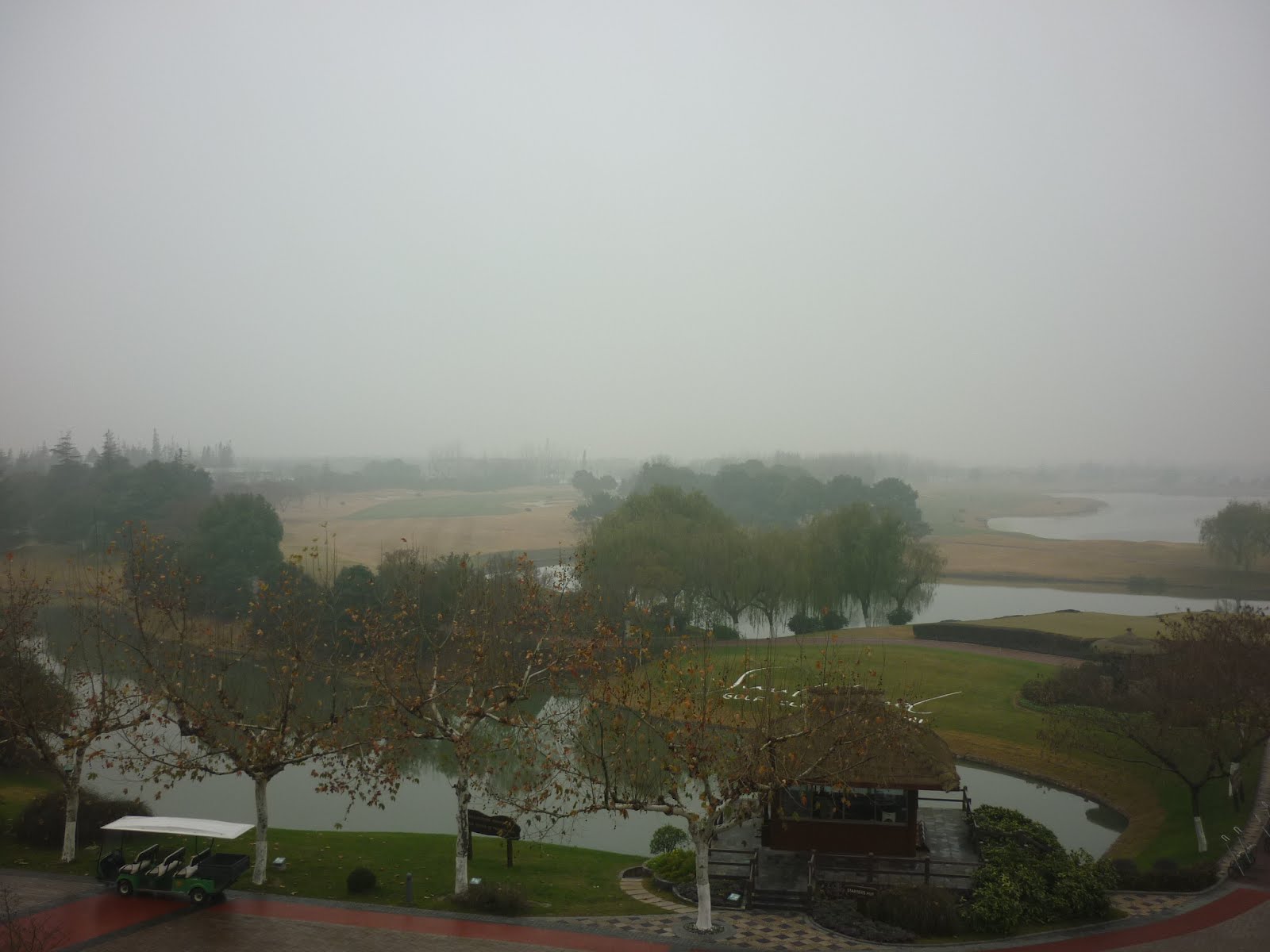
This is the panoramic scene outside the workshop room. The hotel where the workshop took place is situated in a resort style hotel. The view is actually part of a golf course. The temperature in Shanghai at this time is between 0-6 Celcius.


This is another view of the peaceful scenery outside the workshop room.


Lunch break. We were served with 10 course local Chinese dish. Frankly, the food is very different than what we usually have. Nevertheless we tried to eat some of the uniquely served dishes.


That's me in front of the hotel lobby where the workshop takes place. Check out the red banner on the top of the hotel lobby building. This is proof that this is the first SciRP workshop.

Overall, it was a very interesting experiences attending the 1st Scientific Research Publishing Workshop. I was really honoured to meet the founder and president of SciRP as well other professors, academicians and researchers from other parts of the globe. Besides expanding our knowledge we get the chance to meet new people and increase our networking (which is important in the real world).


...................................................................................................................
FREE Recommended magazines to get you updated with current engineering news


Have you downloaded my free "Choosing Alternative Fuel" Ebook? If not, then please download it here. It's Free and on top of getting the free ebook, you'll get eCourse on Alternative Fuel. It's a good and easy way to add more valuable information to yourself.

Importance of Boiler Chemicals Water Treatment

Tuesday, January 24, 2012

Since I have written my experience visiting a boiler manufacturing company recently, I think it is good if I follow up with another article related to boiler. This time, it is about the importance of boiler water treatment chemicals. I remembered monitoring the boiler man blended and poured some chemicals (from Nalco) to be injected into the boilers.

[Flash back: Some of my boiler experience story (explosion) for you to read. Boiler Explosion Part 1 & Boiler Explosion Part 2.]

Do you know that like cooling tower, a boiler also requires chemical treatment for various reasons. When I was a process engineer, I got the opportunity to learn about the chemical water treatments for utility boiler and cooling tower. There are various chemicals with specific functions. The chemicals, which I will explain below will imperatively preserve the life of a utility boiler (in this case a low pressure boiler). A low pressure boiler in this case is one which is less then 200 psi. We shall look upon several chemical parameters, namelu the amines, alkalinity, sulfites and phosphates or polymers of the boiler water.

Amines are used to increase the condensate pH to a range of 7.8 to 8.7. When generating steam, carbonic acid forms and as a result your steam pH is low. Amines are volatile and when introduced into the steam header or boiler water, amines will increase the condensate pH. A low pH will lead to excessive condensate pipe corrosion.

Alkalinity is used to increase the boiler water pH to above 10.5. This serves three purposes. pH above 10.5 will decrease your overall corrosion rates, it will keep a 3:1 ratio of total alkalinity to silica, and it allows the polymer to react with calcium. A 3:1 ratio keeps silica from plating in the boiler. A low pH will result in an over general corrosion appearance on your boiler tubes.

Sulfites are used to remove any dissolved oxygen from the water. Dissolved oxygen enters the boiler in make up water or as air is sucked into the system. Dissolved oxygen is extremely corrosive to your tubes and localized pits will form, ultimately resulting in premature tube failure. Maintain a 20 to 40 ppm residual of sulfite in your boiler water.

Phosphates and polymers are used to react with any calcium in the water. The polymer attaches itself to the calcium. The polymer and calcium then is able to exit the boiler through the surface or bottom blowdown. Phosphate reacts with the calcium and sinks the calcium to the bottom of the boiler. When using phosphates you must perform boiler blowdown daily to release the phosphate and calcium. Failure to use a polymer or phosphate will result in calcium build up on the tubes or as some call it boiler scale. This will decrease the over boiler efficiency and will drastically increase your fuel cost.

It is vital to note that water expands 100,000 times when it change from a liquid to vapor phase. A typical home water boiler 30 gallon system has enough energy to throw a 2,000 pound car over 100 feet in the air if catastrophically failed.

First Image credited to: www.johnstonboiler.com. Second Image credited to http://www.indiamart.com (Example of Nalco Chemical for boiler water treatment).


HIGHLY Recommended GREEN Info Product

"Don't buy solar panels. Instead, Build them - like they did!" Watch the FREE video presentation NOW and discover…
  • Why you should run like hell from $10,000 and $20,000 retail solar panel systems
  • A little known way to slash your electric bill by 80% or more (or even get off the grid entirely)
  • How a “technologically retarded” guy stumbled on a way to generate free energy with homemade solar panels
  • A simple, 5-step process for building your own low-cost solar panels
  • And how to say “goodbye” to the electric company… and “hello” to clean, FREE electricity!
>> Click HERE:- Watch the FREE video presentation NOW!!!

-------------------------------------------------------------------
FREE Recommended magazines to get you updated with current engineering news

Have you downloaded my free "Choosing Alternative Fuel" Ebook? If not, then please download it here. It's Free and on top of getting the free ebook, you'll get eCourse on Alternative Fuel. It's a good and easy way to add more valuable information to yourself.


IEM Technical Visit to Mechmar Boiler

Friday, January 20, 2012

Last November I joined a group of Institution Engineers Malaysia (IEM) members for a technical visit trip to Mechmar Boiler in Pasir Gudang, Johor, Malaysia. This was the first time I visited a boiler manufacturer company. Honestly I was thrilled to learn and explore how a boiler is made and what the factory looks like. I mean the production plant site. In total there were about 20-30 engineers from IEM. The program started at 9.30 am up to 12.30 pm.


Some information about Mechmar Corporation (Malaysia) Berhad

Mechmar Boiler was established over 30 years ago. Currently, Mechmar Boiler is the leading industrial boiler and pressure vessel manufacturer within the Asian Pacific region.

With a core emphasis on superior engineering and strict manufacturing quality standards, Mechmar continually strives and meets the ever increasing expectations of today’s customers for reliable heat, power or steam generation at an economical investment cost.

Mechmar wide product range serves to meet the heat, steam or power needs of our customers regardless of their industry and location. Their products are the result of years of continuous and rigorous detailed engineering and dedication to providing quality in our manufacture and in our service to our customers.

The headquartered of Mechmar is in Kuala Lumpur, Malaysia. Mechmar’s engineering team reinforces their commitment to their customers by providing sound engineering input with attention to detail. With two world class manufacturing and fabrication facilities in South East Asia both of which are ISO9001 certified by Lloyds, we meet this commitment with speed and at competitive prices. (Information taken from Mechmar official website).

Products manufactured by Mechmar

Here are the list of products manufactured by Mechmar Corporation (Malaysia) Berhad:

Oil/Gas-Fired Boiler
  • Titan HT
  • Titan AS
  • Titan MB
Solid Fuel-Fired Boilers
  • Titan MCC
  • Titan MCH
  • Titan BD
  • Titan MTH
-Heat Recovery Boiler
-Various Custom Made Boilers
-Reconditioned boilers

For more comprehensive list of products, please click here.

The factory administrator of Mechmar Boiler gave us some explanation on the history and business of the company.

A nice pen as souvenir for the IEM delegates. Luckily they provided a free pen because I forgot to bring my own pen.

This is the view in the production facility of Mechmar Boiler
One of the oil/gas fired boiler nearly completed

That's me with some nice background in the Mechmar Boiler facility

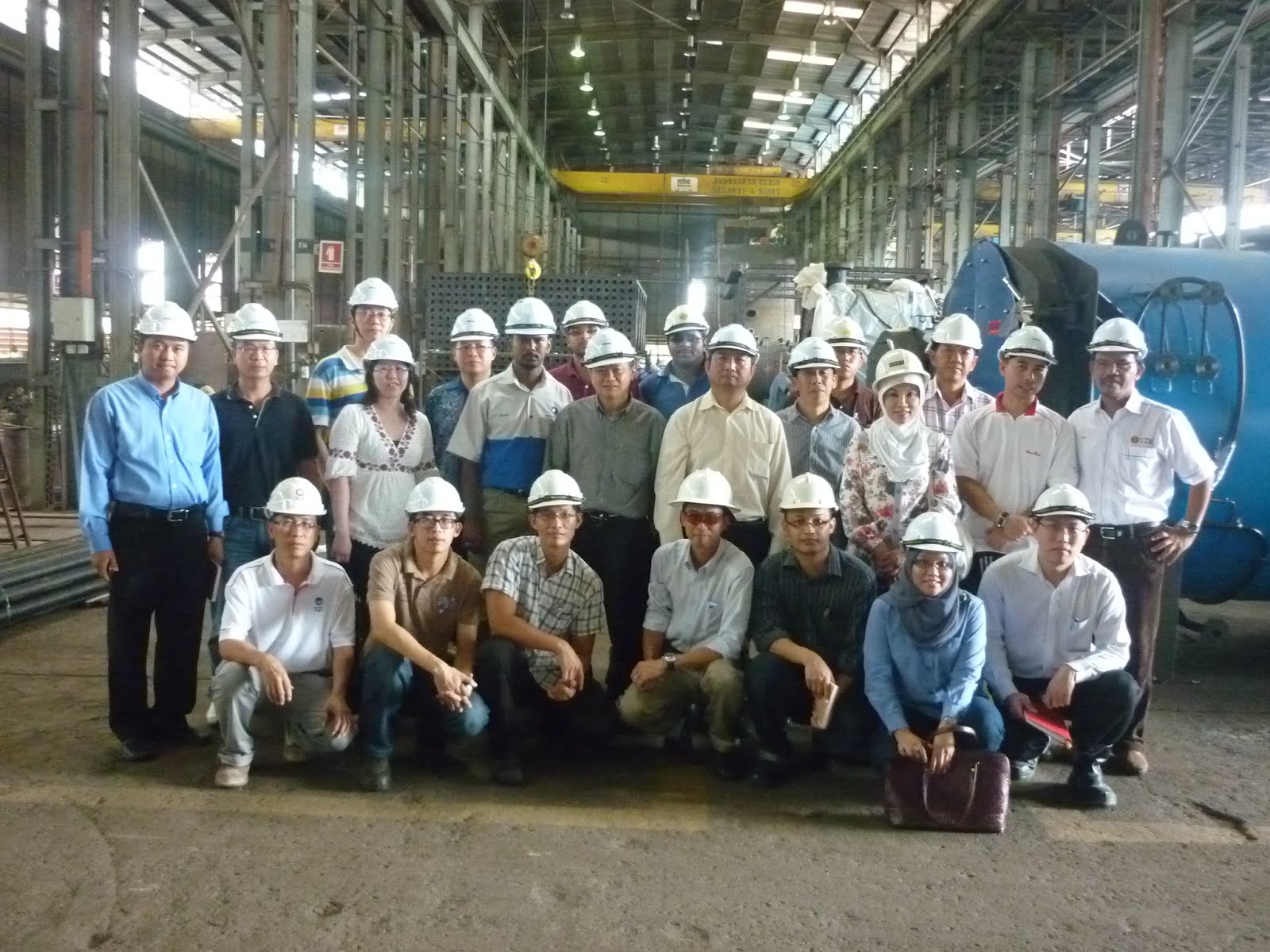
Taking a group photo together in the boiler manufacturing plant


HIGHLY Recommended GREEN Info Product
"Don't buy solar panels. Instead, Build them - like they did!" Watch the FREE video presentation NOW and discover…
  • Why you should run like hell from $10,000 and $20,000 retail solar panel systems
  • A little known way to slash your electric bill by 80% or more (or even get off the grid entirely)
  • How a “technologically retarded” guy stumbled on a way to generate free energy with homemade solar panels
  • A simple, 5-step process for building your own low-cost solar panels
  • And how to say “goodbye” to the electric company… and “hello” to clean, FREE electricity!
>> Click HERE:- Watch the FREE video presentation NOW!!!
.................................................................................................................................


Have you downloaded my free "Choosing Alternative Fuel" Ebook? If not, then please download it here. It's Free and on top of getting the free ebook, you'll get eCourse on Alternative Fuel. It's a good and easy way to add more valuable information to yourself.

Interview By Petroleum Africa Magazine: Trends in Plate Heat Exchangers

Thursday, January 19, 2012

I was approach by Mr Chikezie Nwaoha, a friend from Nigeria and also a Downstream Correspondent of Petroleum Africa Magazine. He is also a Contributing Editor for Control Engineering Asia Magazine and Contributing Editor for PetroMin. Somewhere last year, if I'm not mistaken in July 2011, he emailed me with intention to interview me about cooling tower. The reason for this is because previously I have co-written a book chapter with him about Cooling Towers which will published in a book titled 'Process Plant Equipment Operation, Reliability and Control'. The book which is published by John Wiley will be ready this coming May 2012. I'm so excited and cannot wait to get my hands on this new book. My contribution is in Chapter 5.

Instead of the topic cooling tower, I said why not you interview me about Plate Heat Exchanger because it is my favourite equipment. Well, he said yes. He can interview me about Plate Heat Exchanger. Well, the interview when well and it was published soon in November 2011 in the Downstream Focus section in Petroleum Africa Magazine page 30-33 (4 pages).


- Please click the photo to enlarge -


I'm not sure if I'm allowed to place the interview article here. If I have the permission, I'll make it available for download.

Here is a partial shot from the 3rd page.


- Please click the photo to enlarge -

I hope I can contribute more like this in future. If you want to read Petroleum Africa Magazine, you can try it out and subscribe it here.


...................................................................................................................
FREE Recommended magazines to get you updated with current engineering news


Have you downloaded my free "Choosing Alternative Fuel" Ebook? If not, then please download it here. It's Free and on top of getting the free ebook, you'll get eCourse on Alternative Fuel. It's a good and easy way to add more valuable information to yourself.


Chemical Elements - Made free by Free Blog,SEO Created by Diznews Online
by TNB